
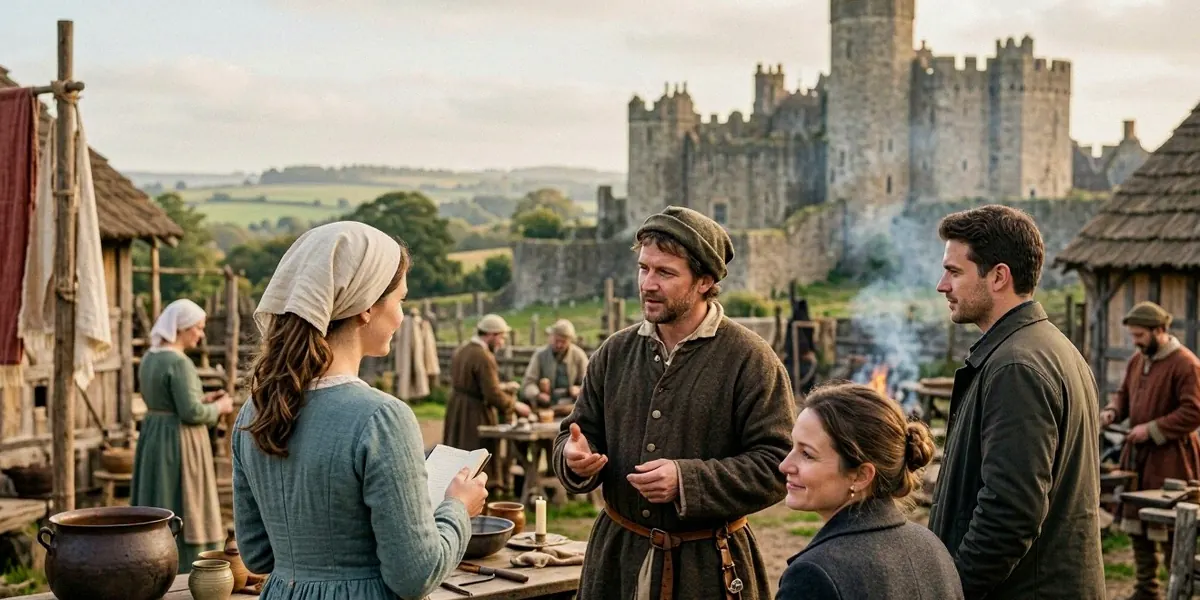
Living History: Education or Entertainment?
The musket smoke has barely cleared when a visitor asks the redcoat whether he is scared of losing. For a moment, the man in the woollen coat stays in character, then breaks into a grin and explains that he is a retired teacher from Leeds who has spent his weekends for eleven years researching the life of a common soldier. It is a small moment, but it captures the central tension we keep returning to on this blog: when a heritage site puts a person in costume and asks them to perform the past, is the goal to teach, to entertain, or something messier in between? Living history sits at the crossroads of public history, museum studies, and show business, and how we answer that question shapes everything from funding to interpretation.
What We Mean by Living History
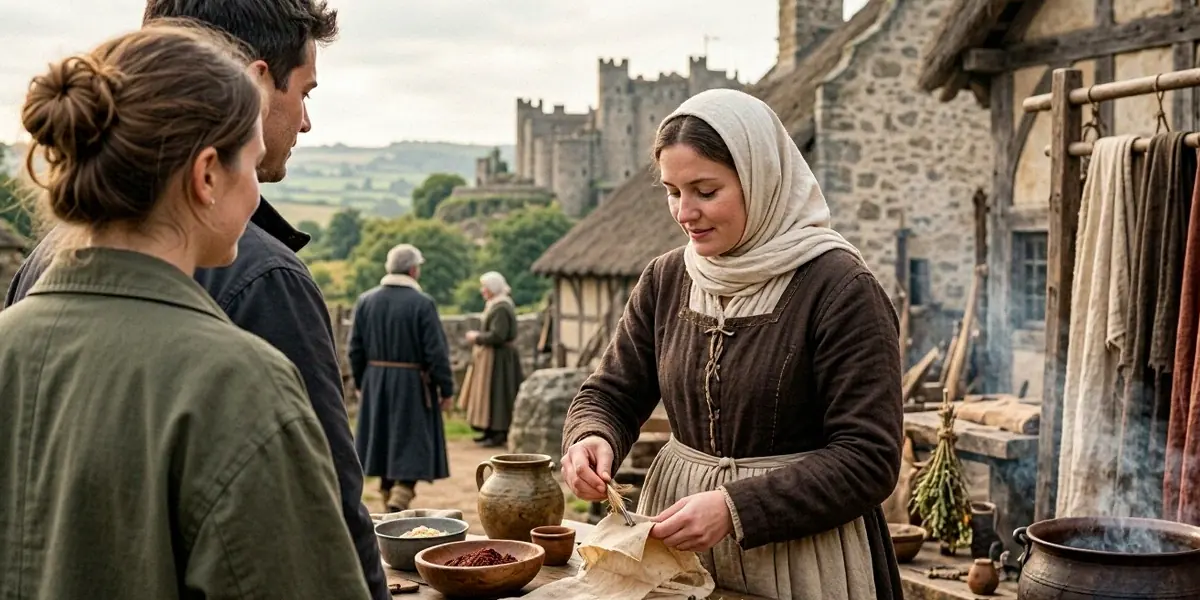
Living history is an umbrella term for any interpretation that uses real people, period clothing, and reconstructed environments to bring the past to life. It ranges from a single costumed demonstrator cooking over an open hearth to large-scale battle reenactments involving hundreds of participants. In the UK, English Heritage operates over 400 historic sites across England and uses costumed interpretation at many of them, from Roman soldiers at Hadrian’s Wall to Tudor cooks at Bolsover Castle. The Museum of London has used costumed actors and object handling to interpret everything from Roman Londinium to Victorian street life, often in urban settings where a full open-air village is not possible.
First-Person vs Third-Person Interpretation
First-person interpretation means the interpreter speaks as a historical character, adopting period language, beliefs, and manners. It is immersive and emotionally powerful, but it can also be limiting: a first-person enslaved worker or factory child cannot easily step out of the role to answer a question about wages or working conditions. Third-person interpretation keeps the costume but allows the interpreter to speak as an informed modern guide, moving between past and present. Most UK sites now blend the two, using first-person for short scenes and third-person for Q&A, which is usually where the real learning happens.
From Pageant to Pedagogy: A Short History
Living history did not begin in museums. It began in pageants, military tattoos, and civic anniversaries, where spectacle was the point. The shift toward pedagogy gathered pace in the twentieth century as open-air museums and heritage organisations began to see costumed interpretation as a tool for teaching rather than simply celebrating. Colonial Williamsburg in Virginia is a benchmark for American Revolution living history and first-person interpretation, and its influence is visible in UK practice, from Beamish Museum in County Durham to the smaller volunteer-run sites that dot the country.
The Case for Education: Learning Through Doing
The strongest argument for living history is that it works. Visitors remember what they physically do and feel far longer than what they read on a label. Handling a reproduction spoon, smelling woodsmoke, or trying to march in step with a group of strangers creates what museum studies scholars call embodied cognition: the body becomes part of the learning process. This is not nostalgia for its own sake; it is a genuine pedagogical method with measurable outcomes.
Cognitive and Emotional Impact on Visitors
Research on museum learning consistently shows that emotional engagement improves recall. A visitor who has just been “recruited” into a regiment and marched across a field is far more likely to remember the logistics of eighteenth-century warfare than one who has skimmed a panel. This is where American Revolution programming at Colonial Williamsburg has been so influential, using first-person interpretation to make political arguments feel urgent rather than abstract. UK sites such as Beamish Museum, an open-air museum where costumed interpreters recreate life in North East England from the 1820s to the 1950s, achieve something similar by letting visitors step into a pit village, a colliery, and a 1900s town.
How Historic House Museums Use Live Interpretation
Historic house museums face a particular challenge: rooms are fragile, furniture is roped off, and the temptation is to deliver a lecture. Live interpretation changes the dynamic. At sites cared for by the National Trust, which looks after hundreds of historic houses and heritage sites across the UK, many of which host live interpretation events, costumed cooks, gardeners, and servants turn static rooms into working spaces. The Royal Armouries in Leeds takes a different approach, using live combat demonstrations to explain how armour and weapons actually functioned, which is far more effective than a glass case alone.
The Case for Entertainment: Spectacle, Attendance, and Funding
We would be dishonest if we pretended heritage sites are not also in the business of attracting visitors. Spectacle sells tickets. The Battle of Hastings reenactment at Battle Abbey in East Sussex draws thousands of visitors each October, with cavalry, archers, and Saxon shield walls filling the field where the battle was actually fought. English Heritage uses events like this to drive membership and revenue, which in turn funds conservation and free school visits. Without the crowds, much of the quieter educational work simply would not happen.
When Spectacle Overshadows Substance
The risk is obvious. When the cannon smoke is the main attraction, interpretation can become a sideshow. Visitors leave remembering the noise and the costumes but not why the battle mattered, who was displaced, or what the consequences were for ordinary people. We have seen this at events where the commentary is drowned out by the crowd, or where the “history” is reduced to a series of dramatic vignettes with no connective tissue. Entertainment is not the enemy, but it becomes a problem when it replaces explanation rather than supporting it.
Commercial Pressures on Heritage Sites
Funding pressures shape interpretation more than most visitors realise. Sites need visitor numbers to justify grants, and events that sell well tend to be the ones that are repeated. This can push programming toward the spectacular and away from the difficult or slow. It also affects staffing: trained interpreters are expensive, and volunteer reenactors are not. The result is a mixed economy in which professional museum educators, passionate amateurs, and commercial event companies all shape what the public sees.
Where the Line Blurs: Ethical and Interpretive Risks
Living history raises questions that labels and panels do not. When you put a human being in front of a visitor, you are making an argument about who belongs in the past and how they should be portrayed. That argument can be honest, or it can be sanitised. The line between education and entertainment is not just aesthetic; it is ethical.
Accuracy vs Dramatic Licence
Reenactors and interpreters constantly negotiate between what is accurate and what is watchable. A historically accurate musket volley is slow, smoky, and often fails to fire. A dramatically satisfying one is loud and reliable. Period clothing is uncomfortable and sometimes poorly documented; theatrical versions are easier to wear and photograph better. The danger is not dramatic licence itself but unacknowledged licence. When visitors cannot tell what is documented and what is invented, the educational value collapses.
Whose History Is Being Performed?
There is also the question of whose stories get told. For decades, living history at UK sites focused on soldiers, monarchs, and craftsmen, with empire and conflict presented as family fun. Debates around sites connected to the slave trade, colonial history, and the British Empire have forced a reckoning. American Revolution reenactments face similar questions: whose revolution is being celebrated, and whose perspectives are left off the field? Good practice means asking these questions before the event, not after the complaints arrive.
What Good Living History Looks Like
None of this means living history is doomed to be either dry or dishonest. The best practice we have seen shares a few common features, and they are not mysterious. They are simply the result of taking interpretation seriously as a craft.
- Clear learning goals written before the costumes are chosen
- Interpreters who are trained in both the history and the technique of audience dialogue
- Space for visitors to ask questions and challenge what they are told
- Honest labelling of what is documented, what is reconstructed, and what is speculative
- Evaluation that asks what visitors actually learned, not just whether they enjoyed themselves
Designing for Learning Outcomes
Successful sites start with the question “what do we want visitors to understand?” and work backwards. The Museum of London has used this approach in its costumed interpretation, tying characters and scenes to specific curriculum and gallery themes. Historic Royal Palaces, which cares for sites including the Tower of London and Hampton Court Palace, uses live interpretation to explore power, ceremony, and everyday life, with clear interpretive threads running through the visitor experience. When the learning goal is explicit, the entertainment serves the education rather than competing with it.
Training Interpreters and Measuring Impact
Training matters more than costume quality. A brilliant interpreter in a rough wool tunic will outperform a poorly briefed one in a perfectly researched outfit. Training should cover historical content, handling difficult questions, working with children and school groups, and knowing when to step out of role. Evaluation should be equally rigorous: short visitor interviews, observation of dwell time, and follow-up surveys can all reveal whether the interpretation is landing. Without evaluation, sites are guessing.
FAQ
Is living history suitable for children?
Yes, when it is designed with them in mind. Hands-on activities, short first-person scenes, and opportunities to ask questions work well for younger visitors. Sites like Beamish Museum and many English Heritage properties run family-focused interpretation that balances accuracy with accessibility. The key is to avoid content that is too violent or complex without context, and to give children a way to participate rather than just watch.
Do reenactors get paid?
It varies widely. Some are professional interpreters employed by museums or heritage organisations, while many are volunteers who participate for personal interest. Commercial reenactment groups may be paid a fee for large events such as the Battle of Hastings reenactment, but individual participants often cover their own costs. This mixed economy has real implications for training, consistency, and the quality of interpretation.
How accurate are historical costumes at these events?
Accuracy ranges from meticulous, based on archaeological and documentary evidence, to loosely inspired. Many UK reenactment groups research period clothing in detail, but practical concerns such as weather, comfort, and cost can lead to compromises. Good sites are transparent about this, explaining what is known and what has been reconstructed.
Can living history handle difficult or traumatic subjects?
It can, but it requires care. Sites interpreting slavery, war, or colonial violence need to think about the emotional impact on visitors and on interpreters, particularly those from affected communities. The best examples use first-person interpretation sparingly, provide clear framing, and offer space for reflection rather than spectacle.
How can I tell if a heritage event is educational or just entertainment?
Look for interpretation that explains context, not just action. If you leave knowing why something happened and who it affected, the event is doing educational work. If you leave only remembering the explosions, it may still be enjoyable, but it is not the same thing. The best events manage both.
Living history can be education and entertainment at the same time, and pretending otherwise does not help anyone. What matters is intention: clear learning goals, trained and supported interpreters, honest interpretation of difficult history, and a genuine commitment to the visitor’s understanding. When those elements are present, the costumes and the cannon fire become tools rather than distractions. We would love to hear about your own experiences at UK heritage sites, whether a brilliant encounter with an interpreter or an event that left you wondering what you had actually learned.