
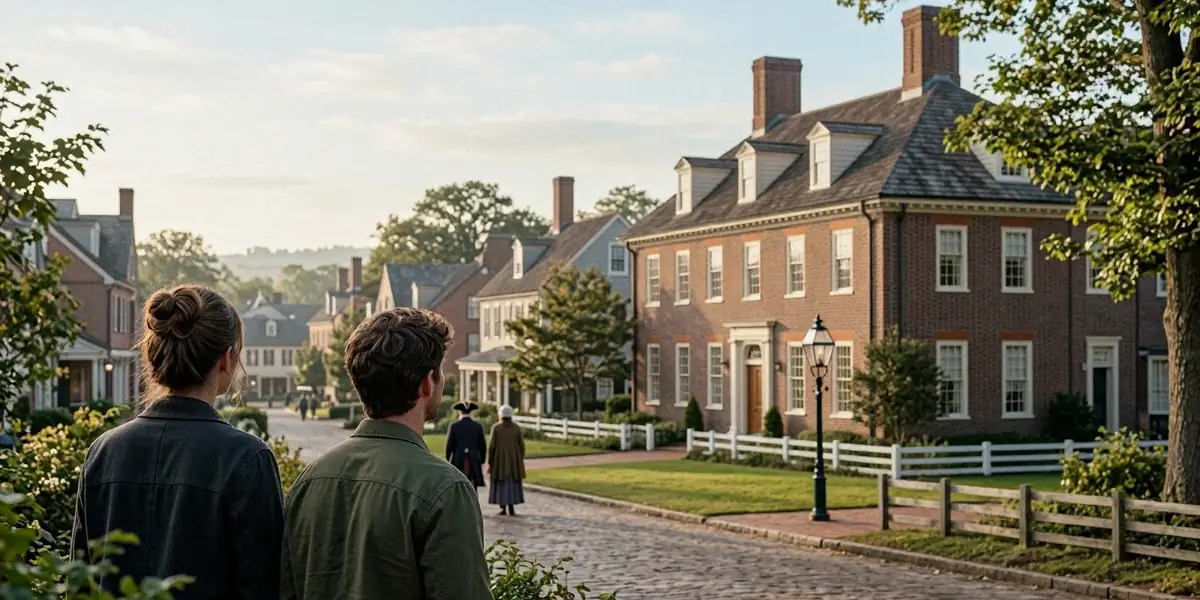
Colonial Williamsburg: Lessons for Heritage Sites
Picture a coach party spilling out into a reconstructed 18th-century street, tickets in hand, costumed interpreters mid-argument about stamp taxes, and a queue forming outside a tavern that serves historically inspired pies. Now picture a small historic house museum in a English market town on a wet Tuesday in February: one volunteer on the desk, a leak in the roof, and a visitor book with three names in it. Both are heritage sites. Both are trying to tell honest stories about difficult pasts. The gap between them is not just money — it is method, and that is where Colonial Williamsburg becomes genuinely useful to those of us working in UK public history.
Why Colonial Williamsburg Matters to UK Public History
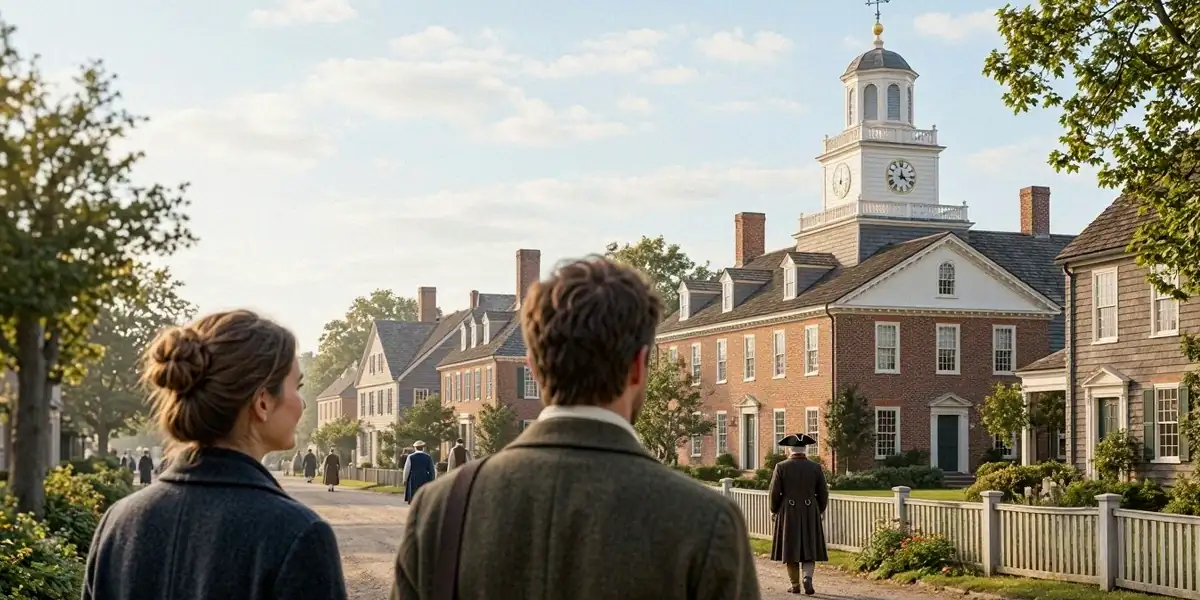
Colonial Williamsburg is the world’s largest living history museum, spanning 301 acres in Virginia, with hundreds of restored and reconstructed buildings, a working historic trades programme, and an annual operation that dwarfs most European heritage attractions. It sits alongside the American Revolution Museum at Yorktown and Jamestown Settlement, its sister sites, forming a triangle of institutions that interpret the colonial and revolutionary period at serious scale.
For UK audiences, the appeal is not nostalgia for empire. It is the fact that Colonial Williamsburg has spent decades wrestling in public with exactly the questions British sites now face: how do you interpret a founding myth when the same streets held enslaved people? How do you stage rebellion when you are also a brand? How do you stay financially viable without turning history into a ride?
The scale and ambition of the Colonial Williamsburg model
The numbers alone are instructive. A 301-acre site requires its own infrastructure: roads, utilities, fire service, archaeology teams, conservators, costumed staff, hotel operations, and a research library. No UK historic house museum operates at this scale. The National Trust in the UK cares for over 500 historic houses, gardens, and monuments, but each property is comparatively small and locally managed. Colonial Williamsburg is effectively a town-sized museum, and that changes what is possible — and what is not.
From preservation to interpretation: a brief history
The site began as a preservation project in the 1920s, funded by John D. Rockefeller Jr., with the aim of restoring Virginia’s colonial capital. Over the following decades it shifted from saving buildings to interpreting people. That shift matters. Preservation asks “how do we stop this falling down?” Interpretation asks “whose story are we telling, and who gets to speak?” Many UK sites are still stuck in the first question.
What UK heritage sites can learn from across the Atlantic
We are not suggesting that a National Trust property in Shropshire should attempt a Williamsburg-style campus. What we can borrow is the discipline of layering: a core preserved fabric, a research spine, a live interpretation programme, and a digital arm that reaches people who will never visit. The lesson is structural, not theatrical.
Interpreting Conflict and Revolution: A Transatlantic Comparison
The American Revolution is Colonial Williamsburg’s central subject, and it is a story of rebellion against a British crown. UK sites interpreting civil conflict — the National Civil War Centre in Newark, the Tower of London, or the many battlefield and siege sites managed by English Heritage — handle a comparable problem from the opposite direction. We are usually interpreting the suppression of rebellion, not its triumph.
Balancing patriotism and critical history
Colonial Williamsburg has been criticised, fairly, for leaning into patriotic celebration, particularly around Independence Day programming. It has also produced genuinely critical work on slavery, loyalism, and Indigenous dispossession. The tension is productive. UK sites face the same pressure from the other side: there is a vocal constituency that wants heritage to be comforting, and another that wants it to be confrontational. The honest position is usually somewhere in the middle, and it requires institutional courage to hold.
The role of costumed interpretation and first-person performance
First-person costumed interpretation is Colonial Williamsburg’s signature. Done badly, it becomes pantomime. Done well, it allows visitors to ask difficult questions of a “person” rather than read them on a panel. UK sites such as Beamish Museum in County Durham, which pioneered the open-air living history approach in the UK, have shown that this can work here without American accents or revolutionary rhetoric. The key is training: an interpreter who cannot step out of character to answer a safeguarding question, or who cannot acknowledge the limits of the historical record, is a liability.
Handling slavery and empire at Colonial Williamsburg and UK sites
Colonial Williamsburg interprets the lives of enslaved people through reconstructed quarters, archaeology, and named individual biographies. It is imperfect and contested, but it is explicit. UK sites have been slower. Country houses with direct links to the transatlantic slave trade, Caribbean plantations, and East India Company wealth have only recently begun to address this in permanent displays. The lesson is that silence is now the riskier choice.
Funding, Ticketing, and the Business of Heritage
Colonial Williamsburg runs a mixed model: a private foundation, substantial endowment income, ticket sales, hotel and restaurant operations, and donor support. It is not a state-funded museum, and it has weathered serious financial difficulties, including major redundancies during the 2008 recession and again during the pandemic.
The economics of living history
Costumed interpretation is expensive. It requires trained people, costume maintenance, research time, and rehearsal. Ticket revenue rarely covers it. Colonial Williamsburg’s hotel and hospitality operations effectively cross-subsidise the museum, which is a model few UK heritage sites can replicate — though the National Trust’s holiday cottages and cafés follow similar logic at a smaller scale.
What UK sites can borrow without selling out
We can borrow the principle that earned income and mission delivery are not opposites. Practical options include:
- Tiered ticketing, with a higher-priced guided experience alongside free general admission
- Membership schemes that offer genuine research or behind-the-scenes access, not just a tote bag
- Partnerships with local universities for funded research and student placements
- Commercial hire of underused spaces, from film crews to community groups
- Digital products — courses, podcasts, publications — that generate income without gatekeeping
Membership, donations, and community buy-in
Colonial Williamsburg’s donor base is broad and American, rooted in a sense of national ownership. UK sites often struggle because the community does not feel the site belongs to them. Community buy-in, built through consultation, volunteering, and shared decision-making, is the more durable funding strategy in the long run.
Community Engagement and Local Voices
Colonial Williamsburg works with descendant communities, including African American families with documented ties to the site, as well as local schools, universities, and researchers. This is not always comfortable — descendant consultation can slow projects down and challenge institutional assumptions — but it produces better history.
Working with descendant communities
UK sites have equivalent obligations. The Windrush generation, South Asian communities linked to empire, and local families whose ancestors worked on estates all have claims on interpretation. The Museums Association and Historic England have both published guidance on inclusive interpretation, and it is worth reading before drafting any new gallery text.
Education programmes and school partnerships
Colonial Williamsburg runs residential and digital education programmes reaching hundreds of thousands of students. UK sites such as Beamish Museum and the Black Country Living Museum have built strong school offers by aligning with the national curriculum and offering genuinely hands-on sessions. The lesson is that education is not an add-on; it is core business.
Volunteers, re-enactors, and the risk of nostalgia
Volunteers sustain most UK heritage sites. Re-enactors bring energy and audiences. But both can pull interpretation towards nostalgia — a version of the past that is comfortable, apolitical, and often quietly exclusionary. The Association for Heritage Interpretation has long argued that interpretation should provoke thought, not just admiration. We agree.
Digital Storytelling and the Future of Historic House Museums
Colonial Williamsburg publishes a podcast, runs a substantial YouTube channel, maintains an online collections database, and produces behind-the-scenes content that reaches audiences far beyond Virginia. None of this requires a Hollywood budget.
Podcasts, blogs, and behind-the-scenes content
A decent podcast can be recorded on a laptop and a £80 microphone. A blog costs nothing but time. The value is in consistency and honesty — audiences respond to research-in-progress, not polished marketing copy.
Virtual tours and accessibility
Virtual tours extend reach to disabled visitors, schools, and international audiences. They also serve as preservation records. UK sites with limited budgets can start with a smartphone, a gimbal, and a free hosting platform.
Avoiding the theme park trap
The risk of digital and live interpretation is that spectacle replaces substance. Colonial Williamsburg has occasionally been accused of this. UK sites should treat it as a warning: if the visitor remembers the horse but not the enslaved blacksmith, we have failed.
Practical Takeaways for UK Heritage Sites
If we were advising a small historic house museum or a heritage site in the UK tomorrow, these are the lessons we would prioritise.
Start with research, not costumes
Before buying a single waistcoat, commission research. Who lived here? Who worked here unpaid? What did the site’s income depend on? Historic England’s research frameworks and local record offices are free starting points.
Train staff to handle difficult questions
Front-of-house staff and volunteers need scripts, but also permission to say “we don’t know” and “that’s contested.” The Museums Association offers training and ethical guidance that many sites underuse.
Measure success beyond visitor numbers
Footfall is a poor proxy for impact. Track dwell time, question frequency, school return rates, community partnerships, and whether visitors can articulate something new they learned. Colonial Williamsburg’s own evaluation work offers useful templates.
FAQ
What is Colonial Williamsburg and why does it matter to UK heritage?
It is the world’s largest living history museum, spanning 301 acres in Virginia, interpreting colonial and revolutionary America. It matters to UK heritage because it has spent decades testing how to interpret contested history at scale — including slavery, empire, and rebellion — with lessons that transfer to British sites.
Is Colonial Williamsburg publicly funded?
No. It is operated by a private non-profit foundation, supported by endowment income, ticket sales, hospitality operations, and donations. This mixed model differs sharply from the free-entry, state-supported model common across many UK national museums.
Which UK sites already use similar living history methods?
Beamish Museum in County Durham pioneered the open-air living history approach in the UK, and the Black Country Living Museum in Dudley has developed a comparable model. Both combine reconstructed buildings, costumed interpretation, and strong school programmes.
How should UK sites handle links to slavery and empire?
Explicitly and with research. The National Trust’s 2020 report on colonialism and slavery is a useful precedent, and the Museums Association provides ethical guidance. Silence is increasingly untenable, and audiences — particularly younger ones — notice it.
What is the single biggest lesson from Colonial Williamsburg?
That interpretation is a discipline, not a decoration. Research, training, community consultation, and honest storytelling matter more than costumes or gift shops. UK sites should adapt that principle to their own local context, not copy the American model wholesale.
Colonial Williamsburg is not a template to be transplanted. It is a case study in ambition, contradiction, and persistence. UK heritage sites — from the National Trust’s 500-plus properties to a single-room museum run by volunteers — should adapt rather than copy, staying rooted in local communities and honest about Britain’s own complex history. That is the work. It is slow, it is contested, and it is worth doing.